You land in Paris, your phone connects, and then you try to call your hotel. Nothing happens, or worse, your home carrier charges you a fortune. Most travel eSIMs give you data only, so regular phone calls are the first thing people miss. At Simmates, travellers ask us almost every week whether a plan with real calling exists for Europe. It does, but you need to know what to look for, because “unlimited” does not always mean what it sounds like.
This guide explains how a Europe eSIM with unlimited calls works, who actually needs one, and how to buy the right plan without paying for features you will never use.
Do You Need a Europe eSIM with Unlimited Calls?
Before you pay extra, ask a simple question: who will you call, and how?
Most travellers do fine with a data-only eSIM and an app like WhatsApp. Calls over the internet cost almost nothing, and they work across Europe once you have a connection. Some countries do block them, as our guide on how to use WhatsApp in Dubai shows, but Europe is not one of them. But some situations call for a real phone number and normal calls.
- Local bookings. Restaurants, taxi firms, and small guesthouses often prefer a phone call or text to an app message.
- Delivery and ride drivers. A driver may call your number when they cannot find you.
- Business travel. Clients and suppliers may only dial a standard number.
- Verification codes. Banks and some apps send codes by text to a phone number, not to an app.
- Emergencies and family. Some people simply feel safer with a number that works like a normal phone.
If none of that sounds like you, a cheaper data plan may be enough. If two or more apply, keep reading.
What “Unlimited Calling” Means on a Travel eSIM
Here is where many buyers get caught. A plan advertised as unlimited may come with fair use rules, country limits, or call types that are not included.
Ask these questions before you pay:
- Are the calls unlimited to local numbers only, or also to international numbers?
- Is there a minute cap or a daily limit hidden in the terms?
- Do incoming calls work, or only outgoing ones?
- Which countries are included in the plan?
- Do text messages come with the plan?
A Europe eSIM with unlimited calls usually covers calls inside the plan’s country list and often caps or excludes calls to numbers outside it. Read the terms before you buy, not after you land.
EU eSIM with Calls and Texts vs Data Only: A Quick Comparison
Not every traveller needs the same thing. This table shows how the main options compare.
| Option | Phone Number | Calls | Texts | Best For |
| Data only travel eSIM | No | Through apps only | Through apps only | Tourists, short trips, budget travel |
| EU eSIM with calls and texts | Yes | Included | Included | Business travel, longer stays, local bookings |
| Local SIM in one country | Yes | Included | Included | Long stays in one country |
| Home carrier roaming | Your home number | Depends on your plan | Depends on your plan | Short trips inside covered zones |
The second row is the one this guide focuses on. It costs more than a data plan, but it gives you a working number without visiting a shop.
Check Your Home Plan First: EU Roaming Rules
Before you buy anything, check what your own carrier already offers. The EU has “Roam like at Home” rules, which mean that if you have a plan from an EU country, using it in another EU country should work as it does at home. The rules also cover Iceland, Liechtenstein, and Norway.
That makes a big difference if you live in the EU. Your calls, texts, and data may already work across the region at no extra cost, within your plan’s normal conditions.
A few limits to know:
- Fair use. If you spend long periods abroad, your carrier may contact you. This rarely affects a holiday.
- The UK and Switzerland. These are not automatically covered, so check your plan.
- Ferries and planes. Networks at sea or in the air can carry separate charges. Switch on aeroplane mode on board if you are unsure.
If you come from outside the EU, for example, from the US, Pakistan, or the Gulf, those rules do not apply to you. That is when an eSIM with calling starts to make sense. If your trip starts in Pakistan or ends there, our Pakistan travel eSIM guide covers the other side of the journey.
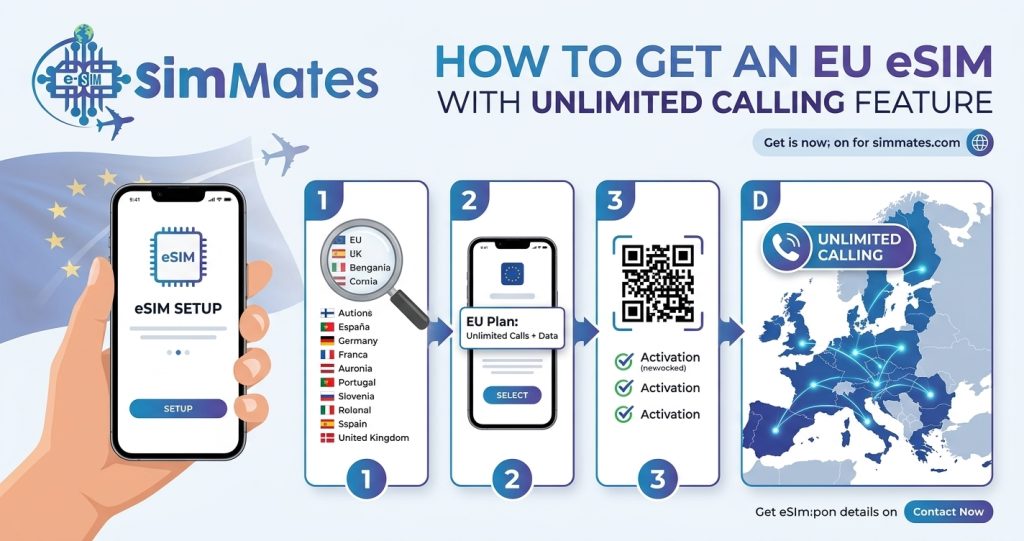
How to Get a Europe eSIM with Unlimited Calls: Step by Step
Buying the right plan takes about ten minutes if you follow the steps below.
- Check your phone. It must support eSIM and not be locked to one carrier. Most iPhones from the XS onward and recent Samsung Galaxy and Google Pixel phones qualify.
- List your countries. Write down every country you will visit, including the UK or Switzerland if they are on your route.
- Choose a plan with calling. Look for a provider that clearly lists calls and texts, not just data.
- Read the call terms. Check minute caps, number restrictions, and whether incoming calls work.
- Buy before you fly. Do it at home, on WiFi, so you have time to fix any problems.
- Install the eSIM. Scan the QR code from your confirmation email and follow the prompts.
- Switch it on when you land. Turn on data roaming for the eSIM, then test a call and a text straight away.
Test the plan on the day you arrive, not on the day you need it most.
Europe Travel eSIM with Phone Number: What to Expect
Many people assume a Europe travel eSIM with phone number works exactly like their home SIM. It is close, but there are a few differences.
The number usually belongs to a European carrier, so friends and family back home will see a foreign number if you call them. If they call you, they may pay international rates to reach it. That surprises a lot of first-time buyers.
For this reason, many travellers keep their home SIM active in the second slot for incoming calls and text codes, and use the eSIM for data and local calls. Your phone can run two lines at once, so you do not have to choose.
Also remember that some providers issue numbers only to buyers who meet identity checks. This is more common with local carriers than with travel-focused sellers, so check before you buy.
How to Pick the Best eSIM for Europe with Calls
There is no single best plan for everyone. The best eSIM for Europe with calls is the one that matches your route, your data needs, and the way you plan to call.
Use this checklist when you compare providers.
- Clear coverage list. The plan names every country it covers.
- Honest call terms. The provider explains limits in plain words, not buried in small print.
- Data that fits your trip. Calls over a network use little data, but maps, photos, and video add up fast.
- A working number. Check whether you keep the number after the trip ends or lose it.
- Support you can reach. Look for live chat or email with fast replies, since a failed install on arrival is stressful.
- Refund rules. Find out if you can get your money back when the eSIM fails to activate.
Price matters, but a cheap plan that fails at the airport costs more than a fair plan that works.
How Much Data Do You Need Alongside Calls?
Calls and texts use very little data, so your data amount depends on everything else you do online. Use this as a rough guide.
- Light use, around 300 to 500 MB a day: maps, messaging, and a few ride or booking apps.
- Moderate use, around 1 GB a day: the above, plus social media and photo sharing.
- Heavy use, 2 GB or more a day: video calls, streaming, or working from your phone.
If you are not sure, check your own usage at home for one normal week. Then add a margin for maps and photos. Our tips to reduce data usage while travelling will help you stretch a smaller plan further. Running out in a foreign city is a worse problem than buying a slightly larger plan.
Unlimited Calling eSIM Europe: Who It Suits Best
An unlimited calling eSIM Europe plan makes the most sense for a few types of travellers.
Business travellers. If you move between countries for meetings, you need to call suppliers and clients without worrying about minutes. A local number also makes you look more reliable to the people you meet.
Digital nomads and long stays. If you stay in Europe for weeks, you will make more calls to landlords, shops, and service providers. A calling plan saves you from app calls that fail on a weak signal.
Families. Parents travelling with teenagers often want everyone on a number they can call without using an app.
Anyone who dislikes app calls. Some people just prefer a normal phone call that rings the usual way.
If you are a short trip tourist who only needs maps and messages, you probably do not need this. A data plan and WhatsApp will do the job for less.
Real World Example
Picture a small design agency with two staff members flying to a trade fair in Milan, then on to Munich and Vienna. They need to call suppliers, confirm deliveries, and reach each other on site.
Before the trip, they check three things. Their phones support eSIM. The plan covers Italy, Germany, and Austria. The call terms include both outgoing and incoming calls. They buy two plans, install them at home, and test a call between the two phones the night before flying.
On arrival, everything works. A supplier in Milan calls the local number directly. They keep their home SIMs active for text codes from their bank. The only surprise comes later, when a colleague in London calls the eSIM number and pays an international rate, which they could have avoided by calling out from the eSIM instead.
The lesson is simple. Test before you travel, keep your home SIM for verification codes, and tell people who call you which number to use.
Common Mistakes to Avoid
- Assuming every Europe eSIM includes calls. Most do not, so check the plan page.
- Reading “unlimited” as “no limits at all” without checking the terms.
- Forgetting that the UK, Switzerland, and some other countries may sit outside the plan.
- Turning off your home SIM and then missing bank text codes.
- Installing the eSIM for the first time at the airport instead of at home.
- Buying a plan with a phone number but giving that number out before you test it.
- Skipping the refund and support rules until something goes wrong.
A Smarter Way to Choose
If your trip is short and your needs are simple, start with a data eSIM and use WhatsApp for calls. You will spend less and get everything most tourists need. If you need a real number, choose a plan that states calls and texts clearly and lists its countries.
Simmates lists travel eSIM plans by country and region, so check the Europe eSIM plans for the latest data options, and confirm call and number details on the plan page before you buy. Providers change their terms often, so what was true last season may not be true today.
Final Thoughts
A Europe eSIM with unlimited calls solves a real problem, but only if you pick the right one. Check your home plan first, read the call terms carefully, and make sure the countries on your route are covered.
Install the plan at home, test a call before you fly, and keep your home SIM active for text codes. That small bit of preparation turns a stressful arrival into an easy one.
Related Guides
- Pakistan Travel eSIM Guide: What Tourists Need to Know
- How to Reduce Data Usage While Travelling
- How to Use WhatsApp Calls in Dubai and UAE Without Restrictions
- eSIM for Rare Destinations: Tuvalu, Niue, Macao and Western Sahara
Frequently Asked Questions
1. Can I get a Europe eSIM with unlimited calls as a tourist?
Yes, some providers sell eSIMs with calls, texts, and a European phone number. Many travel eSIMs are data-only, so check that the plan page lists calls before you buy.
2. Does “unlimited calling” really mean unlimited?
Not always. Plans often have fair use rules, country limits, or exclusions for international numbers. Read the terms for minute caps and restrictions.
3. Will I get a phone number with a Europe travel eSIM?
Only if the plan says so. A Europe travel eSIM with a phone number usually gives you a number from a European carrier. Data-only plans do not include one.
4. Can I use WhatsApp instead of buying a calling plan?
Yes, for most trips. WhatsApp calls work well over a data connection and cost almost nothing, as long as you manage your data use on longer trips. A calling plan helps when people need to reach you on a standard number.
5. Do EU roaming rules already cover my phone?
If you have a plan from an EU country, “Roam like at Home” rules generally let you use it across the EU and EEA as you would at home, within fair use. The UK and Switzerland are not automatically covered, so check with your carrier.
6. Can I keep my home number active while using an eSIM?
Yes. Most phones support two lines at once, so you can keep your home SIM for incoming calls and text codes and use the eSIM for data and local calls.
7. Will calls to my eSIM number cost my friends extra?
They might. If your eSIM number belongs to a European carrier, people calling from outside Europe may pay international rates. Calling them from your eSIM, or using WhatsApp, is often cheaper.
8. Which phones work with an EU eSIM with calls and texts?
Most iPhones from the XS onward and recent Samsung Galaxy and Google Pixel phones support eSIM. Your phone must also be free of carrier locks, so check this before you buy.