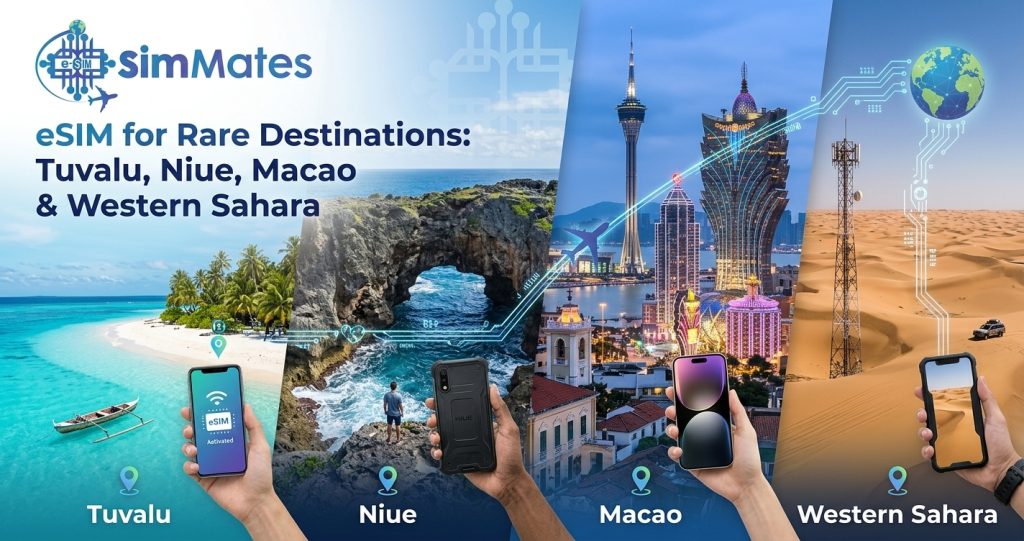
Most travel guides cover eSIM travel for places like Paris, Tokyo, or New York. Almost nobody writes about the places that actually leave travelers stuck without signal. At Simmates, we hear from a small but steady group of travelers every month asking the same question: does an eSIM even work in Tuvalu, Niue, Macao, or Western Sahara? The short answer is yes for three of these four, with one important exception worth knowing before you fly.
This guide breaks down what to expect in each destination, what actually works on the ground, and where the marketing on some provider websites gets ahead of reality.
Why Rare Destinations Need Different Research
Popular tourist countries have dozens of local carriers competing for your business, which makes eSIM travel planning easy. Rare destinations flip that. Sometimes there is one telecom provider on the entire island. Sometimes the political status of the territory affects what infrastructure even exists.
That is exactly why generic “buy any eSIM and go” advice falls apart here. Each of these four places has its own quirks, and knowing them ahead of time saves you from a dead phone on day one.
eSIM Tuvalu: What to Expect on the Ground
Tuvalu is one of the smallest and most remote nations on earth, with a population under twelve thousand people spread across a handful of atolls. Mobile coverage exists but is limited outside the main island of Funafuti.
An eSIM Tuvalu plan will get you data for browsing, messaging apps, and email in most populated areas. A few things worth knowing before you rely on it:
- Voice calling over the traditional network is often unavailable on travel eSIMs here. You will need a VoIP app like WhatsApp for calls.
- Speeds run on the slower side, typically 3G or basic 4G rather than anything faster.
- Coverage thins out fast once you leave Funafuti, so do not expect a strong signal on outer islands.
If you are visiting Tuvalu for research, diplomacy, or simply chasing one of the world’s least visited countries, set expectations low on speed and high on the value of just having any connection at all.
Niue eSIM: A Small Island With a Surprisingly Workable Setup
Niue sits in the South Pacific with a population under two thousand, making it one of the smallest self-governing nations anywhere. Despite the size, a Niue eSIM plan tends to work more smoothly than you might expect, mainly because the island runs a single well-maintained telecom network covering most inhabited areas.
Practical notes for anyone heading there:
- Coverage is solid around the capital, Alofi, and thin out in more remote coastal areas.
- Data speeds are reasonable for a Pacific island this size, generally enough for messaging, maps, and light browsing.
- Because so few travelers visit, do not expect a large number of eSIM providers to list Niue by name. Check availability directly before booking your trip.
Divers and hikers heading to Niue for its coral coastline often ask if they will lose signal entirely once away from town. The honest answer is yes in some spots, so download offline maps before you set out.
eSIM Macao: The Easiest of the Four
Macao is a different story entirely. As a major gaming and tourism hub connected closely to mainland China and Hong Kong, its telecom infrastructure is modern and dense.
An eSIM Macau plan is one of the most reliable options on this list. You can expect:
- Strong 4G and widely available 5G coverage across the territory.
- Fast activation, usually within minutes of landing.
- A wide range of provider options, since Macao is a popular stop for business and leisure travelers alike.
One detail that catches people off guard: Macao, Hong Kong, and mainland China each require separate data plans in many cases, even though they sit close together geographically. If your trip covers all three, check whether your eSIM Macao plan actually includes cross-border coverage or if you need a regional China plan instead.
eSIM Western Sahara: The One That Needs Real Caution
Western Sahara is the outlier on this list, and honesty matters more here than anywhere else. The territory is disputed, with Morocco administering the majority of it while the Polisario Front claims independence for the region. Because of this long-running dispute, telecom infrastructure is tied closely to Moroccan networks in the areas Morocco controls.
What this means practically for an eSIM Western Sahara plan:
- In Moroccan-administered areas, coverage generally works through networks connected to Morocco’s telecom system.
- Some eSIM providers list Western Sahara separately, but in practice your connection may route through a Moroccan carrier.
- Coverage outside the main administered towns can be sparse to nonexistent, particularly in desert regions.
If your travel plans include Western Sahara, verify with your specific provider whether their listed coverage reflects genuine local infrastructure or a broader regional plan that happens to include the territory on paper. This is one destination where checking reviews from someone who has actually traveled there beats trusting a coverage map alone.
How to Use WhatsApp and Calls in These Destinations
Across all four destinations, one pattern repeats. Traditional voice calling through your eSIM is either unavailable or unreliable, while apps like WhatsApp handle voice and video calls just fine over data.
- In Tuvalu and Niue, plan on WhatsApp or a similar app as your primary calling method.
- In Macao, both traditional calls and WhatsApp work without issue thanks to strong infrastructure.
- In Western Sahara, calling reliability depends heavily on which network your connection routes through.
This matters for business travelers especially. If a client call is scheduled during a trip to any of these places, test your connection a day ahead rather than assuming it will just work.
Comparison Table: eSIM Reliability Across These Four Destinations
| Destination | Coverage Quality | Speed | Voice Calls | Best For |
| Tuvalu | Limited, mainly Funafuti | 3G to basic 4G | VoIP apps only | Remote travel, research trips |
| Niue | Good near Alofi, thins elsewhere | 4G in populated areas | VoIP apps recommended | Diving, hiking, small group travel |
| Macao | Strong across the territory | 4G and 5G widely available | Both traditional and VoIP | Business travel, tourism, gaming trips |
| Western Sahara | Inconsistent, tied to admin zones | Varies widely | Unreliable, check locally | Only with prior local verification |
Real World Example
A freelance photographer working on a Pacific island documentary project needed reliable data across three of these stops in a single month. Before the trip, coverage research through Simmates flagged Tuvalu as the weakest link, so the plan was to rely entirely on WhatsApp for calls there and save phone calls for stops with better infrastructure.
In Niue, the same eSIM performed better than expected, with enough signal near the main town to upload photo previews daily. Macao required no special planning at all, since coverage there matched any major city. The lesson from that trip applies broadly: research each stop individually rather than assuming one eSIM plan behaves the same way everywhere.
Practical Tips Before You Travel
- Buy and activate your eSIM travel plan a day or two before departure so you can troubleshoot any install issues while you still have reliable WiFi.
- Download offline maps for Tuvalu and Niue specifically, since coverage gaps are common outside main towns.
- For Western Sahara, contact your provider directly and ask which network your data will route through before assuming full coverage.
- Keep WhatsApp updated and test a call on WiFi before you leave, since that will likely be your main calling method in three of these four destinations.
- Carry a backup plan, whether that is a second eSIM provider or your home carrier’s roaming option, for destinations with thinner infrastructure.
Final Thoughts
Rare destinations reward travelers who do their homework. Tuvalu, Niue, and Macao all support workable eSIM travel setups, each with its own limits worth knowing ahead of time. Western Sahara is the one place on this list where blind trust in a coverage map can leave you stranded, so verify before you go rather than after you land.
Whichever of these four places is on your itinerary, a little research now saves a lot of frustration once you are there.
Frequently Asked Questions
Q1. Does eSIM travel work in Tuvalu?
Yes, though coverage is limited mostly to Funafuti and speeds tend to run slower than you would find in larger countries. Voice calls typically need a VoIP app like WhatsApp rather than the traditional network.
Q2. Is Niue eSIM coverage reliable for daily use?
It is reasonably reliable near the capital, Alfama, but weakens in more remote coastal or hiking areas. Most travelers find it sufficient for messaging, maps, and light browsing.
Q3. Can I use an eSIM Macao plan across Hong Kong and mainland China too?
Not always. Macao, Hong Kong, and mainland China often require separate coverage even though they are close together, so check whether your plan includes all three before relying on it during a multi-stop trip.
Q4. Why is an eSIM Western Sahara plan harder to verify than the others?
Western Sahara is a disputed territory, and telecom infrastructure in the areas Morocco administers is tied to Moroccan networks. Some providers list the territory separately without clarifying how coverage actually routes.
Q5. Will WhatsApp calls work in all four of these destinations?
WhatsApp generally works well in Macao and Niue, works in Tuvalu as the primary calling method, and is less predictable in Western Sahara depending on network routing.
Q6. Do I need a different eSIM for each of these countries?
In most cases, yes, since regional plans that include one of these destinations do not always include the others. Check each provider’s coverage list by name rather than assuming a broad regional plan covers all four.
Q7. What is the biggest mistake travelers make with eSIM travel to remote places?
Assuming a coverage map guarantees a working connection. Remote destinations like Tuvalu and Western Sahara benefit from checking recent traveler reports, not just provider marketing pages.
Q8. Is Macao the easiest of these four destinations for connectivity?
Yes, by a wide margin. Macao’s infrastructure is modern and dense, making it comparable to any major city rather than a rare or remote destination in terms of coverage quality.