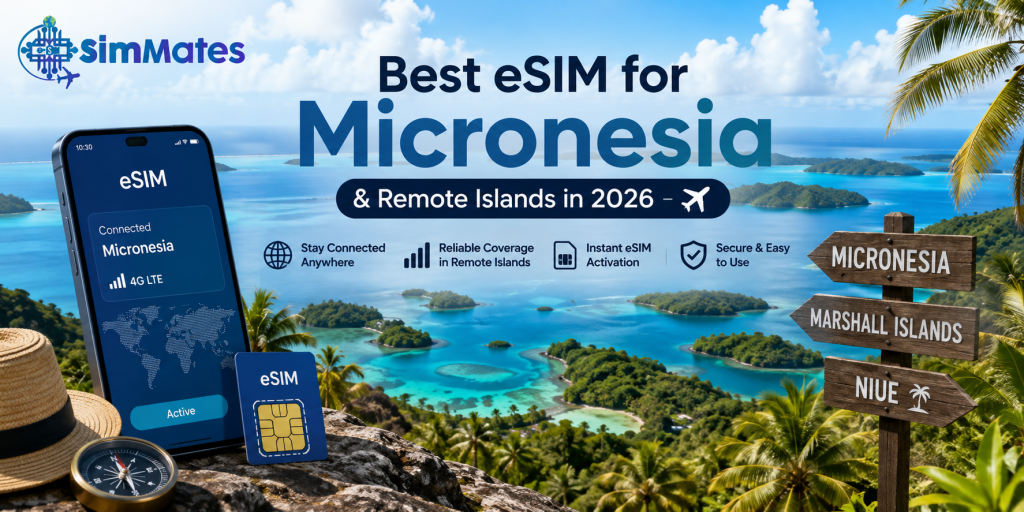
Some destinations are remote by definition: a scattering of atolls in the middle of the Pacific, a single runway on an island most people couldn’t point to on a map. That remoteness is exactly what draws travelers in, but it also raises a fair question before departure: will your phone actually work there?
If you’re researching the best eSIM for Micronesia, the Marshall Islands, Niue, or similarly quiet corners of the Pacific, the honest answer is that connectivity in these places is real but limited, and it varies significantly from island to island. A travel eSIM is generally the most practical way to get local data without hunting for a physical SIM card on arrival, but it isn’t a substitute for realistic planning.
Providers such as Simmates offer travel eSIMs that cover multiple destinations, simplifying data access across a Pacific itinerary. This guide walks through how eSIM technology works in remote settings, what to expect island by island, and how to prepare so a weak signal doesn’t turn into a real problem.
Why Remote Islands Present Connectivity Challenges
Mobile networks are built where population density and infrastructure investment justify the cost. Remote islands, by contrast, often have small populations spread across widely separated atolls, limited undersea cable access, and infrastructure that depends heavily on satellite backhaul. The result is coverage that can be solid in a main town and nearly absent a short distance away.
This isn’t a flaw in eSIM technology; it’s a reflection of the underlying physical network. No eSIM, travel SIM, or roaming agreement can create infrastructure that doesn’t exist locally.
How Travel eSIMs Work
An eSIM is a digital SIM profile installed directly onto your phone’s built-in chip, activated by scanning a QR code rather than inserting a physical card. A travel eSIM typically provides data access through a local carrier or regional partner network in the country you’re visiting, without requiring you to find a shop or swap out your existing SIM.
Once installed, you can toggle the travel eSIM’s data on when you land and keep your home SIM active separately for calls and texts, giving you a data connection wherever the local network reaches, without disturbing your primary line.
Benefits of Using an eSIM Instead of a Physical SIM Card
- No need to locate a local SIM vendor, which can be difficult or nonexistent on smaller islands.
- Instant activation via QR code, useful when you land somewhere with limited retail infrastructure.
- Your physical SIM card stays safe and untouched, with no risk of losing a tiny plastic card while island hopping.
- Easier to manage multiple destinations on one trip, since several eSIM profiles can be pre-installed before departure.
Mobile Coverage Expectations in Remote Destinations
It’s important to set realistic expectations. Even the best eSIM for Micronesia or similar remote destinations depends entirely on the local network infrastructure it connects to. In practice, this usually means:
- Reasonable coverage in main towns, airports, and larger resorts.
- Weaker or absent coverage on outer islands, atolls, and during inter-island boat or small-plane transfers.
- Data speeds that may be noticeably slower than what you’re used to at home, particularly outside town centers.
No eSIM provider can promise identical performance across every island in a region; coverage genuinely depends on the local carrier’s infrastructure in that specific location.
Offline Preparation Before Arrival
Given these limitations, offline preparation isn’t optional for remote island travel; it’s a core part of planning. Before you fly:
- Download offline maps for each island or region you’ll visit.
- Save accommodation addresses, confirmation numbers, and phone numbers in a notes app that works without the internet.
- Screenshot or save ferry/flight schedules between islands.
- Download any offline translation packs you might need.
Messaging Apps While Abroad
Apps like WhatsApp, iMessage, and Telegram work over any internet connection, including a travel eSIM’s data, so they generally remain your most reliable way to stay in touch when a stable signal is available. In areas with intermittent coverage, messages typically send as soon as a connection reappears, which makes messaging apps more forgiving than voice calls for patchy remote networks.
Internet Speeds in Remote Regions
Expect variability. Main hubs like Palikir in Micronesia or the town center on Niue may offer usable 4G speeds for browsing, maps, and messaging. Outlying atolls often rely on older network generations or satellite-based backhaul, which means slower speeds and higher latency. Streaming video or large uploads may be impractical outside main population centers, even with an active data connection.
Local Mobile Infrastructure
Much of the connectivity in these regions depends on undersea cable links and satellite relay stations rather than dense terrestrial towers. Micronesia, for example, has seen infrastructure investment tied to submarine cable projects connecting it to broader Pacific networks, but coverage still concentrates around administrative centers rather than spreading evenly across every atoll.
Network Availability Considerations
Before relying on a travel eSIM in these regions, it helps to check:
- Which local carrier the eSIM provider partners with in that specific country.
- Whether that carrier’s network reaches the specific islands on your itinerary, not just the country overall.
- A typical traveler reports on network reliability for that destination, since infrastructure can change year to year.
Device Compatibility
Not every phone supports eSIM, and coverage aside, your device needs to be eSIM-compatible and unlocked to use one at all. Most recent flagship iPhones and Android phones support eSIM, but it’s worth confirming your specific model before booking a plan for a remote itinerary where backup options may be limited.
Data-Saving Tips for Remote Travel
- Disable automatic app updates and background data syncing.
- Download maps, music, and entertainment before you lose signal.
- Use messaging apps’ data-saving or low-bandwidth modes where available.
- Turn off high-resolution photo/video auto-backup while on limited data.
Dual SIM Advantages for Island Travel
Dual SIM support lets you keep your home SIM active for calls and SMS while your travel eSIM handles data, which is particularly useful when island hopping; you don’t need to reconfigure anything between destinations covered by the same eSIM plan, and your number stays reachable throughout.
Avoiding Expensive Roaming Charges
Traditional roaming can charge steep per-MB rates, which becomes especially costly in regions where towers are sparse and connections may repeatedly drop and reconnect, each potentially registering as new roaming sessions. A travel eSIM with a set regional data allowance is typically a more predictable and often more affordable alternative for these trips.
Travel Safety Through Mobile Connectivity
In remote settings, having any data connection, even an intermittent one, supports basic safety: checking weather before a boat transfer, contacting accommodation if plans change, or reaching emergency services where available. This is one of the more practical, non-promotional reasons to have a working travel eSIM rather than relying solely on hotel Wi-Fi.
Best Practices Before Departure
- Install your eSIM while still on reliable home Wi-Fi, since some remote airports have weak or no Wi-Fi for activation.
- Confirm the eSIM plan’s coverage explicitly lists your destination islands, not just the wider region.
- Pack a portable power bank, since finding charging options on small islands can be inconsistent.
- Tell someone your itinerary and expected check-in times, given that connectivity may be intermittent.
Common Connectivity Mistakes Travelers Make
- Assuming a country-wide eSIM plan guarantees coverage on every outer island within that country.
- Not downloading offline maps before losing signal between islands.
- Relying entirely on hotel Wi-Fi, which can also be limited or shared across many guests.
- Forgetting to check coverage specifically for inter-island transfers, not just endpoints.
When Wi-Fi May Be Necessary
In some remote locations, hotel or resort Wi-Fi, often satellite-based, may be more consistent than mobile data on outer atolls. It’s reasonable to plan for a mix: mobile data via your travel eSIM in town centers, and Wi-Fi as a backup where available, rather than expecting one solution to cover the entire trip.
Choosing the Right Data Plan
Look for plans that specify actual country or regional coverage rather than vague marketing language, and consider your realistic usage: messaging and maps use far less data than video calls or streaming. For island-hopping itineraries, a plan covering multiple Pacific destinations can be more convenient than buying separate eSIMs for each stop.
Responsible Expectations for Remote Destinations
The single most useful mindset for remote island travel is treating connectivity as a convenience, not a guarantee. Coverage varies by local carrier, geography, and even weather conditions affecting satellite links. Planning for gaps rather than being surprised by them makes for a smoother trip regardless of which eSIM you choose.
Destination Spotlight: eSIM Micronesia
Typical connectivity situation: The Federated States of Micronesia has patchy but improving mobile coverage, concentrated around Pohnpei, Chuuk, Yap, and Kosrae’s main towns.
Tourist expectations: Expect workable data in and around main population centers, with significant drop-off on outer islands and during boat transfers.
Mobile network considerations: Coverage depends on the local carrier’s tower placement, which is denser near state capitals than in outer atolls.
Best preparation tips: Download offline maps for each state you’ll visit, and don’t assume a signal will carry over from one island group to another.
Ideal traveler profile: Adventure travelers and eco-tourists comfortable with intermittent connectivity, rather than those needing constant access for work.
Destination Spotlight: eSIM Marshall Islands
Typical connectivity situation: Coverage centers around Majuro and Ebeye, with very limited service across the country’s many outer atolls.
Tourist expectations: Reasonable data access in Majuro; expect little to no signal on remote atolls or during inter-island boat travel.
Mobile network considerations: The Marshall Islands’ network infrastructure is limited compared to larger Pacific nations, so an eSIM Marshall Islands plan should be understood as covering populated hubs rather than the entire archipelago.
Best preparation tips: Save all accommodation and transfer details offline before leaving Majuro, and pack physical backups of important documents.
Ideal traveler profile: Independent travelers and researchers with flexible schedules who don’t require constant connectivity.
Destination Spotlight: eSIM Niue
Typical connectivity situation: Niue is a single small island nation, so coverage is more consistent island-wide compared to scattered atoll nations, though still modest by global standards.
Tourist expectations: Reasonable coverage in and around Alofi and along main roads, with some remote coastal or forest areas experiencing weaker signal.
Mobile network considerations: An eSIM Niue plan typically connects to the island’s single main network operator, so performance is fairly consistent across the destination rather than split across many islands.
Best preparation tips: Confirm your eSIM plan explicitly includes Niue, since it’s sometimes overlooked in broader “Pacific Islands” regional plans.
Ideal traveler profile: Travelers seeking a quieter, less digitally connected experience who still want basic data access for safety and navigation.
Table 1: Remote Destination Connectivity Comparison
| Destination | Mobile Coverage | Tourist Infrastructure | Recommended Data Usage | Offline Preparation Needed |
|---|---|---|---|---|
| Micronesia | Moderate in main towns, weak on outer islands | Limited, concentrated around state capitals | Light messaging, maps, occasional browsing | High |
| Marshall Islands | Limited, centered on Majuro/Ebeye | Minimal outside main hubs | Light essential communication only | High |
| Niue | Moderate, fairly consistent island-wide | Small but organized for tourism | Light to moderate | Moderate |
Table 2: Travel eSIM vs. International Roaming
| Factor | Travel eSIM | International Roaming |
|---|---|---|
| Setup | QR code activation before or after arrival | Often automatic, sometimes requires enabling |
| Cost | Fixed regional data package | Often higher per-MB or per-day charges |
| Convenience | No physical card, easy multi-destination use | No setup needed, but can be costly |
| Flexibility | Can combine multiple islands/countries in one plan | Tied to home carrier’s roaming agreements |
| Coverage | Depends on local partner network per destination | Depends on home carrier’s roaming partnerships |
How Simmates Helps Travelers Stay Connected in Remote Destinations
Simmates offers travel eSIMs designed for instant digital activation, which is particularly useful when traveling through areas with limited retail infrastructure for buying physical SIM cards. Rather than needing a different SIM for each stop, travelers covering multiple Pacific destinations can often use a single eSIM plan spanning several countries.
Because the eSIM is data-only and installed via QR code, setup can typically happen before departure, while still on reliable home Wi-Fi, a practical advantage for remote itineraries where local activation support may be limited. As with any provider, actual performance depends on the local network infrastructure available at each specific destination, so it’s worth checking coverage details for your exact islands before travel rather than assuming uniform service across an entire region.
Real-World Use Cases
Backpacker exploring Micronesia: A backpacker island-hopping between Pohnpei and Chuuk installs a regional eSIM before departure, using it mainly for messaging and offline map syncing in port towns, with realistic expectations of no signal during ferry crossings.
Couple vacationing in the Marshall Islands: A couple staying in Majuro uses their travel eSIM for daily communication and photo sharing, while planning a signal-free day trip to a nearby atoll by downloading everything they need in advance.
Digital nomad working from Niue: A remote worker based temporarily in Alofi relies on a combination of the local eSIM’s data and their accommodation’s Wi-Fi for video calls, treating the eSIM as backup connectivity rather than their sole internet source.
Cruise traveler visiting multiple Pacific islands: A cruise passenger stopping at several island nations uses one multi-country eSIM plan to avoid buying separate local SIMs at each port, checking coverage details for each stop in advance.
Adventure photographer traveling to remote destinations: A photographer documenting outer atolls prepares by downloading offline maps and saving key contacts before departure, using the travel eSIM opportunistically whenever near a town center with signal.
Table 3: Travel Preparation Checklist
| Step | Action |
|---|---|
| Check Device Compatibility | Confirm your phone supports eSIM and is unlocked |
| Install eSIM | Activate your travel eSIM while on reliable home Wi-Fi |
| Download Offline Maps | Save maps for every island or region on your itinerary |
| Save Hotel Details | Store addresses and confirmations in an offline-accessible app |
| Emergency Contacts | Save local emergency numbers and embassy contacts |
| Offline Translation | Download translation packs if needed for the destination |
| Power Bank | Pack one, since charging options may be limited on remote islands |
Expert Travel Tips
- Check whether your eSIM provider lists your specific destination islands, not just the country name, since coverage can vary within a single nation.
- Treat any remote-island eSIM as a supplement to preparation, not a replacement for offline planning.
- When possible, ask locally about which network has the best coverage on the specific atoll or island you’re visiting; this can vary from what’s listed generally.
- Keep a physical backup (printed itinerary, cash, paper map) for stretches where no connectivity is expected.
Key Takeaways
- The best eSIM for Micronesia or other remote Pacific destinations still depends heavily on local infrastructure, which varies significantly by island.
- An eSIM Marshall Islands or eSIM Niue plan should be understood as covering main population hubs, not guaranteeing signal across every atoll or coastal area.
- Offline preparation maps, saved contacts, and translation packs are essential for remote island travel regardless of which eSIM you choose.
- Dual SIM support lets you keep your home number active for calls while your travel eSIM handles data.
- No eSIM for remote islands can promise universal coverage; realistic expectations make for smoother travel.
Conclusion
Finding the best eSIM for Micronesia, the Marshall Islands, Niue, or any similarly remote destination starts with accepting an honest premise: connectivity out there will be good in some places, patchy in others, and occasionally absent altogether. A travel eSIM makes getting local data simpler than hunting for a physical SIM card on arrival, and it’s generally a more affordable option than traditional roaming, but it works within the limits of the local network, not around them. Prepare offline, check coverage for your specific islands rather than the country as a whole, and treat mobile data as one part of a broader travel plan rather than the whole plan itself.
FAQs
What is the best eSIM for Micronesia?
The best eSIM for Micronesia is one that explicitly lists coverage for the specific islands you’re visiting, such as Pohnpei or Chuuk, rather than a vague regional plan. Expect moderate coverage near main towns and weak or no signal on outer atolls.
Can you use an eSIM in the Marshall Islands?
Yes, an eSIM Marshall Islands plan can provide data mainly around Majuro and Ebeye, where local network infrastructure is concentrated. Coverage on outer atolls remains limited regardless of provider, so plan for offline stretches.
Does eSIM work in Niue?
Yes, an eSIM Niue plan typically connects to the island’s single network operator, offering fairly consistent coverage around Alofi and main roads. Some remote coastal or inland areas may still have weaker signals.
Is a travel eSIM better than roaming?
For most travelers, yes, a travel eSIM often provides more predictable pricing through a fixed data package, compared to potentially high per-MB roaming charges. Actual value depends on your specific roaming rates and the eSIM plan’s coverage.
Should you install an eSIM before traveling?
Yes, when possible. Installing your eSIM while on reliable home Wi-Fi avoids relying on airport or hotel Wi-Fi in destinations where connectivity may be limited or unavailable upon arrival.
Why is mobile coverage inconsistent on remote islands?
Remote islands often have small, scattered populations and limited investment in mobile infrastructure, relying on undersea cables or satellite backhaul. This creates strong coverage in main towns but weak or no coverage elsewhere.
Do all Pacific island nations have similar eSIM coverage?
No. Coverage varies significantly based on each nation’s size, population distribution, and infrastructure investment. A single-island nation like Niue may have more consistent coverage than a scattered atoll nation like the Marshall Islands.
Can I use WhatsApp with a travel eSIM in remote destinations?
Yes, WhatsApp and similar messaging apps work over any available data connection, including a travel eSIM. In areas with intermittent signal, messages are usually sent once a connection becomes available again.
What should I download before losing signal on a remote island?
Offline maps, translation packs, saved accommodation details, and emergency contact numbers are the most important items to download or save before you lose a reliable signal.
Is Wi-Fi more reliable than mobile data on remote islands?
It depends on the location. Some resorts use satellite-based Wi-Fi that can be more consistent than mobile data on outer atolls, so it’s often practical to plan for a mix of both rather than relying on just one.
Do dual SIM phones help while island hopping?
Yes, dual SIM support lets you keep your home number active for calls and texts while your travel eSIM handles data, which is convenient when moving between islands covered by the same eSIM plan.